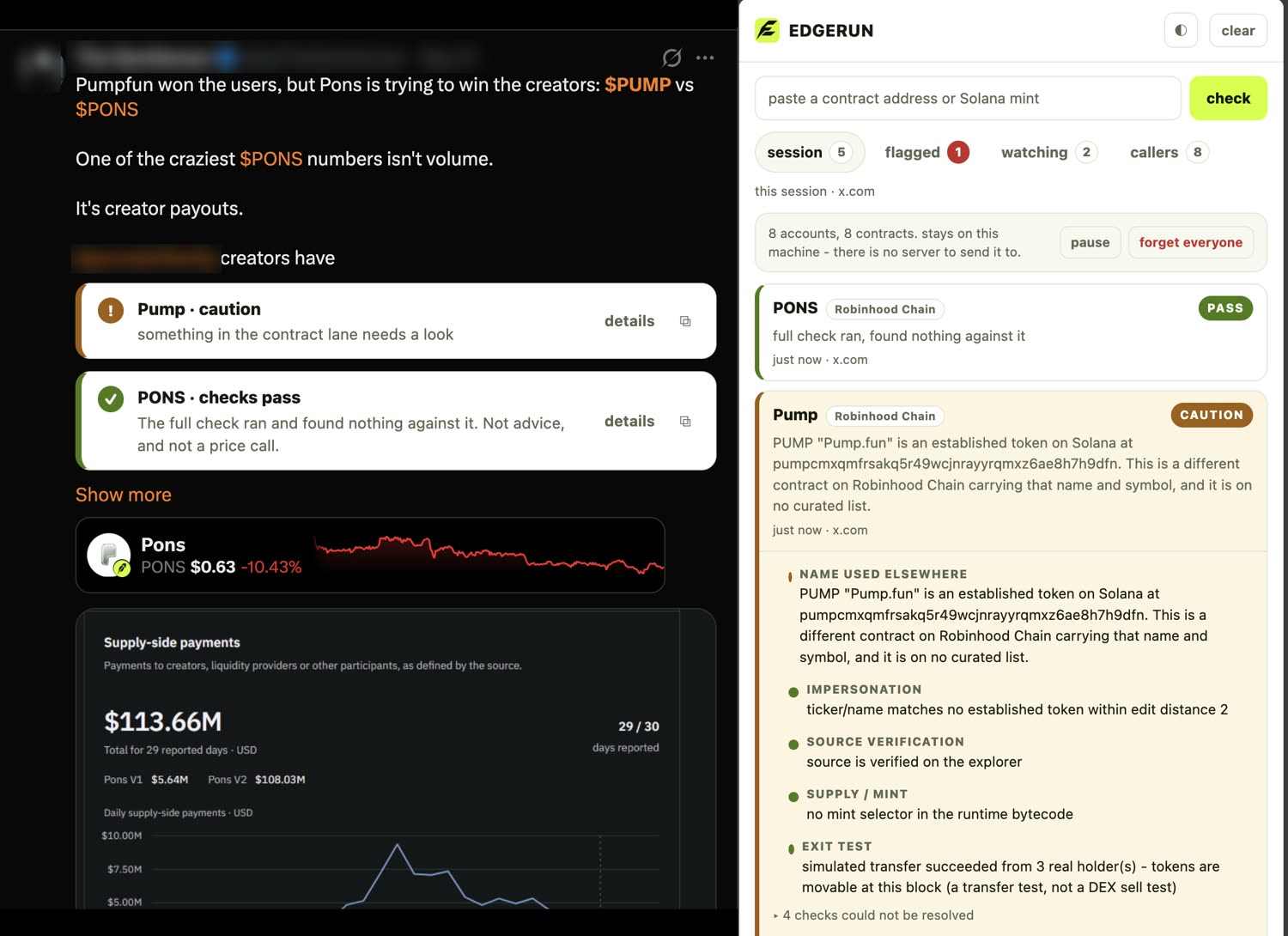
@someaccount
Six chains · browser extension · no serverThe ticker in that post
The ticker in that post
is not one token.
Seven contracts use $PEPE here. Six use $HOOD. Anyone can deploy a token called Tesla • Robinhood Token, and 213 already have.
EDGERUN checks the contract while you are still reading the post - in your browser, across Robinhood Chain, Ethereum, Base, Arbitrum, BNB Chain and Solana. Then it keeps the half every scanner throws away: who put it in front of you.
Works on X, Dexscreener and Blockscout - or paste any contract address or Solana mint into the extension itself.
6chains read live, no API key anywhere
213counterfeits found across ten tickers
0servers on the path, and nothing of yours leaves
Install it in two minutes
not in the Chrome Web Store yet - loaded from the repo, which means you can read every line first01Download it
and unzip it somewhere you will not delete by accident. The dialog carries the file’s SHA-256 so you can check what you got, and a link to the source if you would rather build it yourself.
02Load it in your browser
Open , turn on Developer mode (top right), click Load unpacked and pick that extension/ folder. Works in Chrome, Brave, Edge and Arc.
03That is it - no account, no key
Nothing to sign up for and nothing to configure. The checks run in your own browser against the chain, so there is no server to trust and nothing of yours leaves the machine.
Then just use the internet
On X
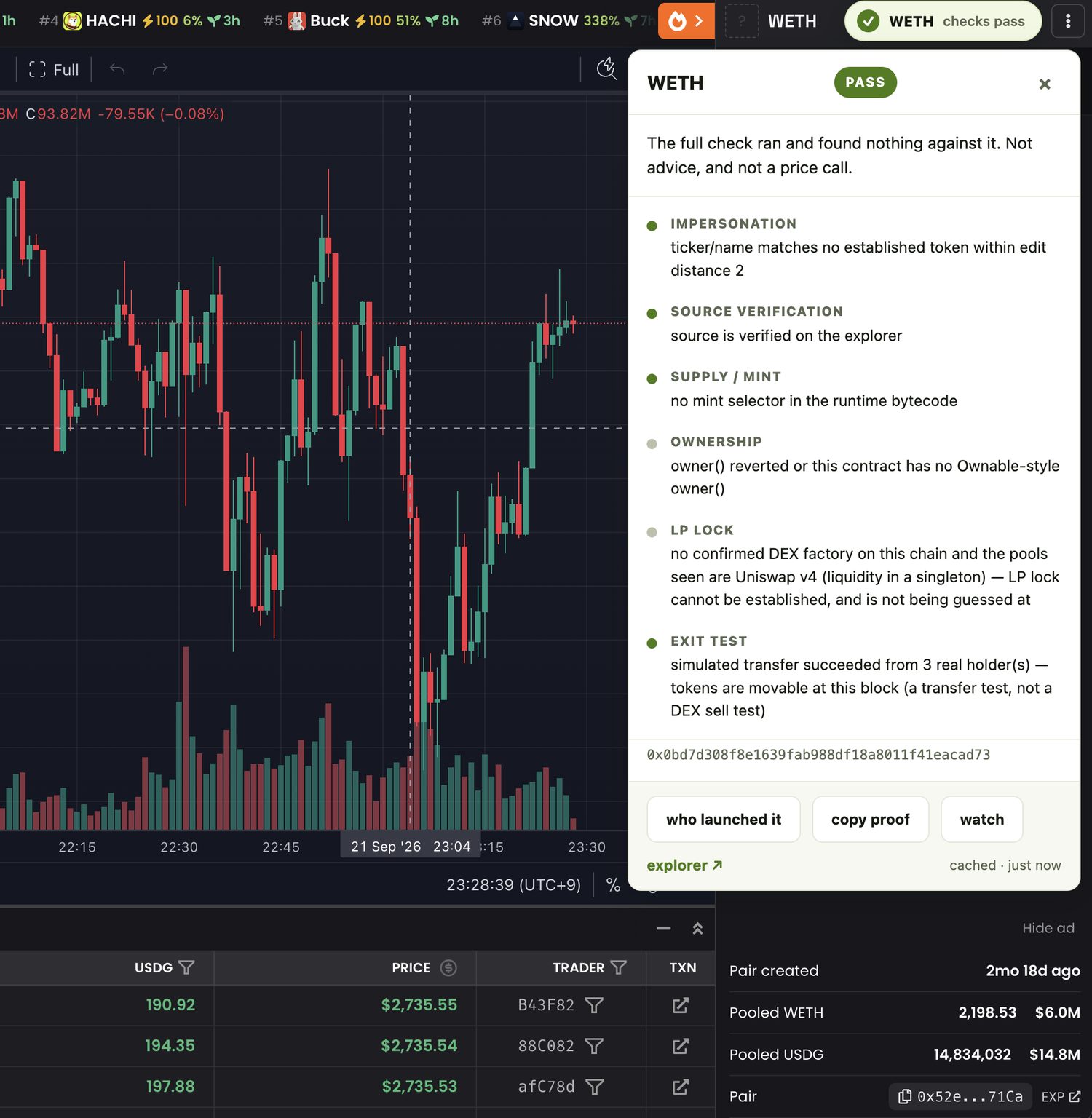
Scroll normally. A post naming a contract address or a Solana mint gets a badge under the text - one per token, because a post naming three contracts is talking about three things. A bare $TICKER with no address stays quiet on purpose.
Who posted it
Every contract arrived attached to an account, and the panel keeps that half: how many contracts an account has put in front of you, how many came back flagged, and whether several accounts arrived on the same contract inside the same few minutes. Local only, with one button that forgets all of it.
On Dexscreener and the explorer
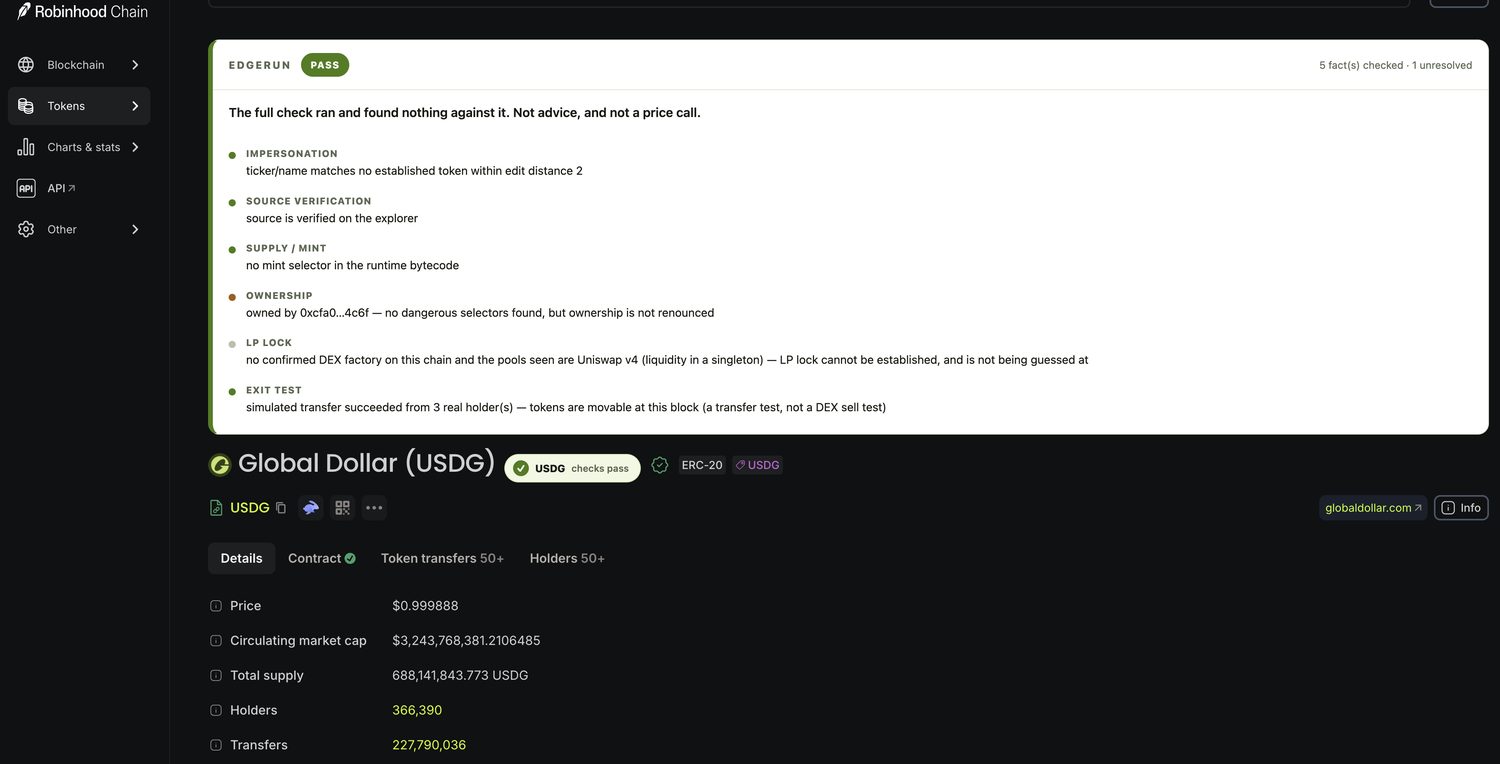
Open any pair or token page. The badge sits in the header and runs the full check: source verification, mint selectors, ownership, deployer history, and a simulated transfer out of a real holder's wallet.
Anywhere else
Click the toolbar icon and paste a contract address or a Solana mint - one box, both alphabets. Same checks, plus a watchlist that tells you what moved since you last looked.
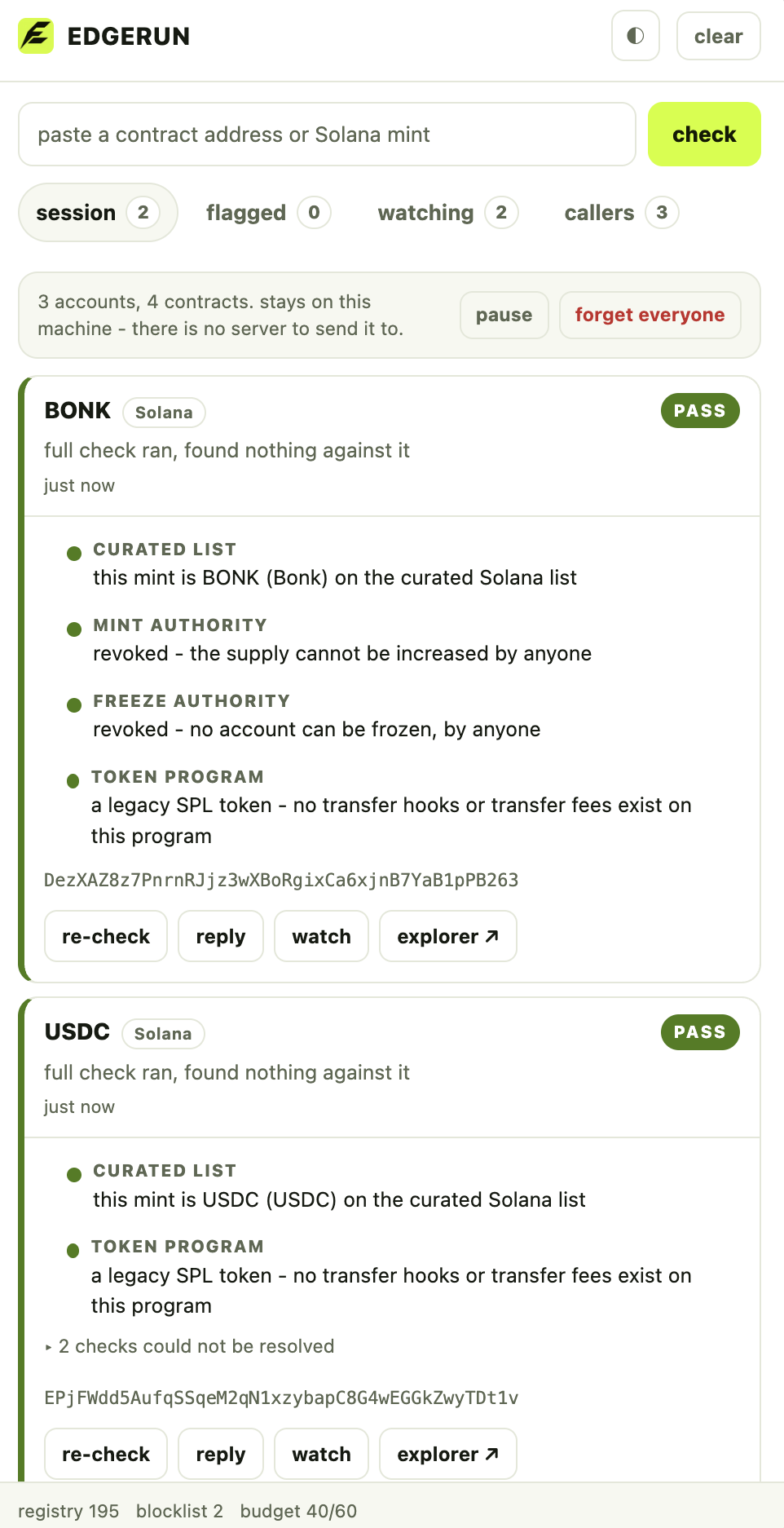
Every badge names the number behind it and links to the explorer, and a report carries the exact commands that check it - so a red verdict is never something you have to take on trust. A token with no flags is not safe, only unremarkable.
Six chains, and what each one can actually prove
every endpoint public, keyless and batched - there is no API key anywhere in this repoRobinhood Chain
4663registryFull contract lane plus the issuer's own registry: source, mint selectors, ownership, deployer history, and a simulated transfer out of a real holder's wallet.
Ethereum
1listIdentity, curated lists, and whether it wears the name of a token that lives elsewhere.
Base
8453listIdentity, curated lists, cross-chain name.
Arbitrum One
42161listIdentity, curated lists, cross-chain name.
BNB Chain
56listIdentity and lists. No public Blockscout instance exists for this chain, so source, creator and holders stay unresolved rather than being faked from somewhere else.
Solana
SPLlistMint authority, freeze authority, transfer hooks, transfer fees and Token-2022 metadata - read from the mint account itself.
registry
The issuer publishes which address is real. Impersonation is provable, and the extension is allowed to say so. Only Robinhood Chain qualifies.
list
Curated token lists only. A collision is reportable - this calls itself USDC and the list says USDC here is a different address - but nothing can be called a fake, because no list is authoritative about what the real one is.
Being absent from a list is never a warning. Every token is unlisted on the day it launches and most legitimate ones stay unlisted forever. Treating absence as a finding is the fastest way to build a tool that cries wolf on every new launch, so it is reported as unresolved and nothing more.
An
0x address is not a token. It is a slot number every EVM chain has.The same forty characters can be a stablecoin on one chain, a honeypot on another and empty on a third, and the post that pasted it rarely says which. So the panel asks all of them at once. “USDT on Ethereum only” ends the question. “Deployed on 3 chains under different symbols” starts a better one.
What it looks like
real output on real contracts, not mockups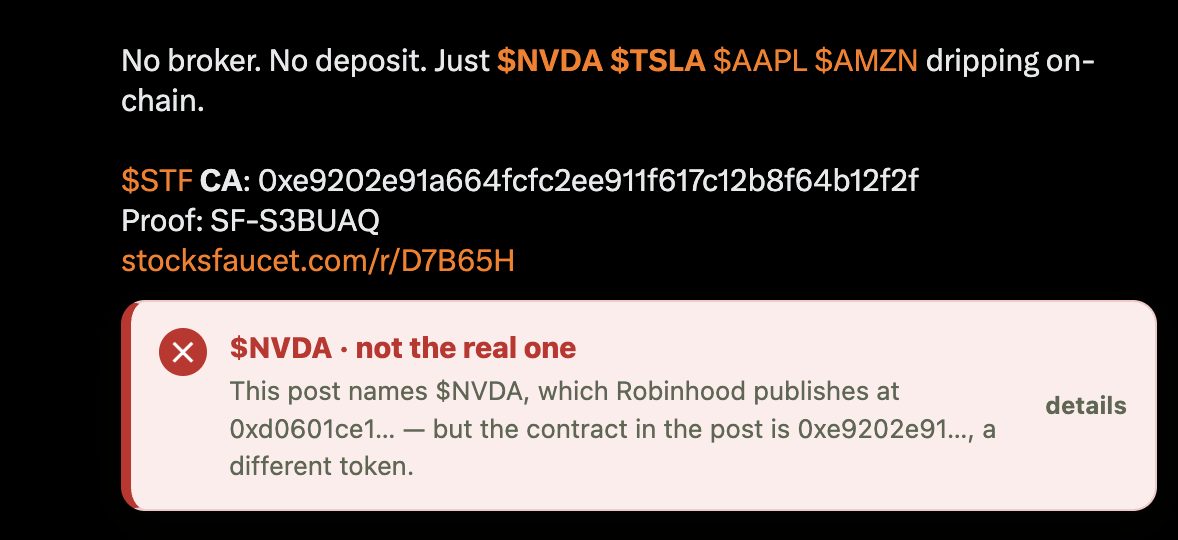
RESTRICTEDCIRCUIT 9,515 neuronsCOUNCIL 5 modulesFEED RH Chain 4663ACQUIRING
Underneath: five modules
reading every block.
The extension answers one question about one contract. This is the other half: the whole chain, watched continuously, by five modules that mostly decide to say nothing.
-block
-transfers/min
-wallets
-tokens moving
…neurons live
waking the circuit…
The council
RULES · IN THIS TAB05GATE
basal ganglia · outputwaiting on synthesis…
The gate stays silent unless confidence and evidence clear a fixed bar, so most rounds say nothing - that is the design. Each seat is a rule here, not a language model: it can only see what a threshold already knows. The reasoning version runs the same five seats as separate model calls and publishes below.
Everything moving right now
3-minute window · ★ to watch · click a column to sort, a row to send it through the circuit| token | flags | worth a look | flow/min | wallets | new | 1-addr | accel | swaps | novelty | moves like |
|---|---|---|---|---|---|---|---|---|---|---|
| reading the chain… | ||||||||||
Why a real circuit
The mushroom body turns an input into a sparse code: of 5,177 traced cells only ~5% fire, and which 5% depends on the input. Similar inputs share most of their code, unrelated ones almost none - the same trick behind locality-sensitive hashing. Every synapse drawn here is measured, not invented.
What the flags mean
- one wallet one address sits on most of the transfers
- printing new supply is being minted right now
- heating flow is well above the token's own average
- fresh wallets the buyers are addresses not seen before
What it is not
Not advice and not a price call. Every flag is a plain threshold on measured activity and names the number behind it, so you can check it yourself on the explorer. A token with no flags is not safe - it is only unremarkable in the last three minutes.